Frank JK
-
Posts
7 -
Joined
-
Last visited
Content Type
Profiles
Forums
Gallery
Downloads
Blogs
Events
Store
Aircraft
Resources
Tutorials
Articles
Classifieds
Movies
Books
Community Map
Quizzes
Videos Directory
Everything posted by Frank JK
-
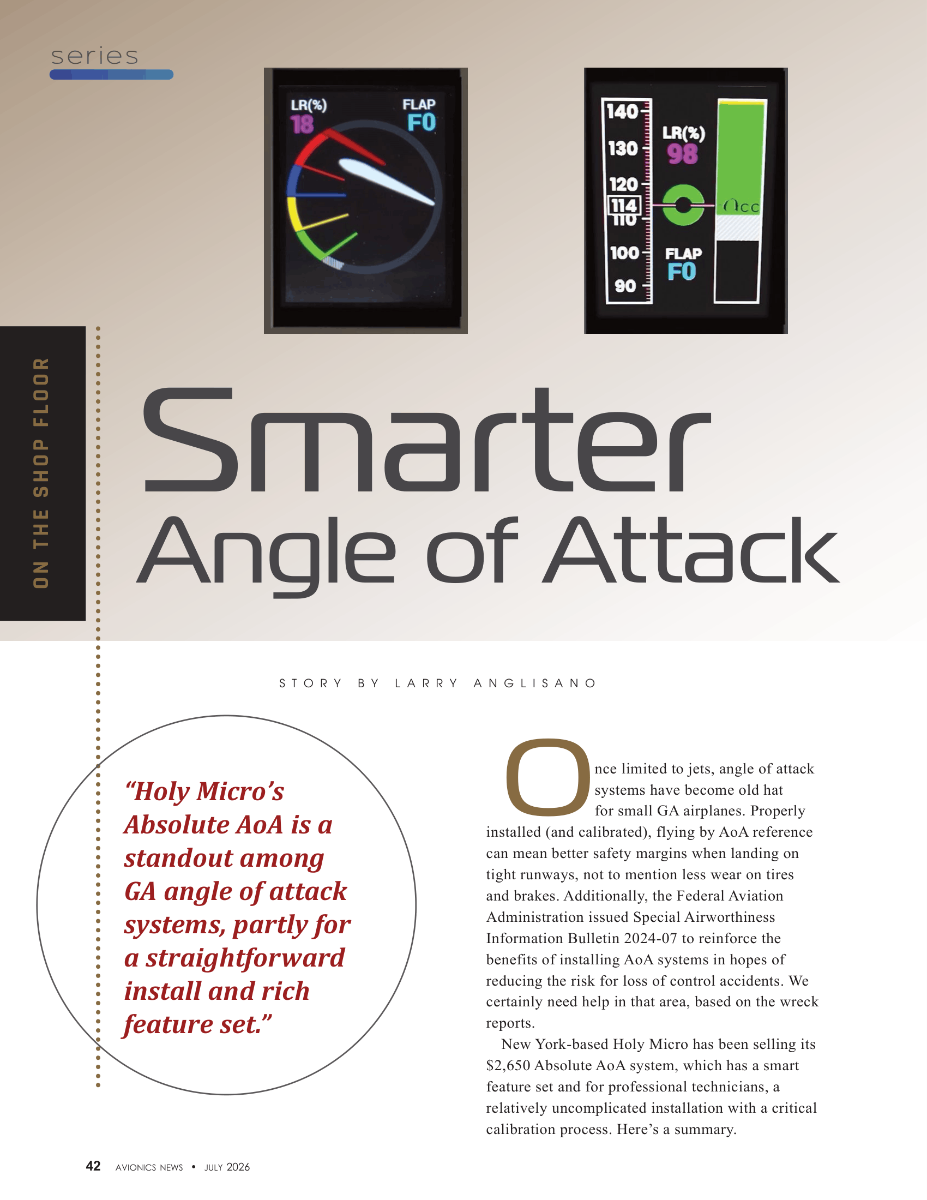
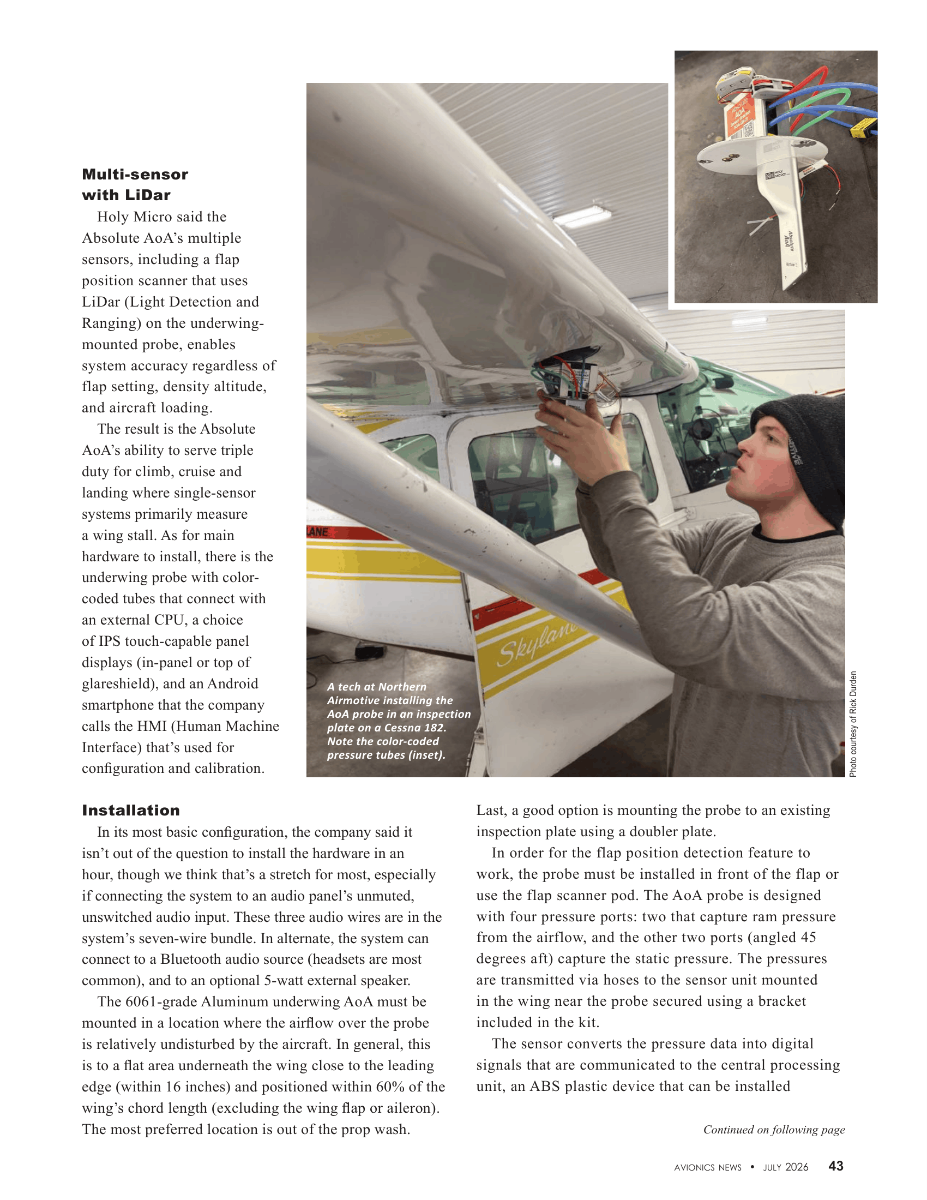
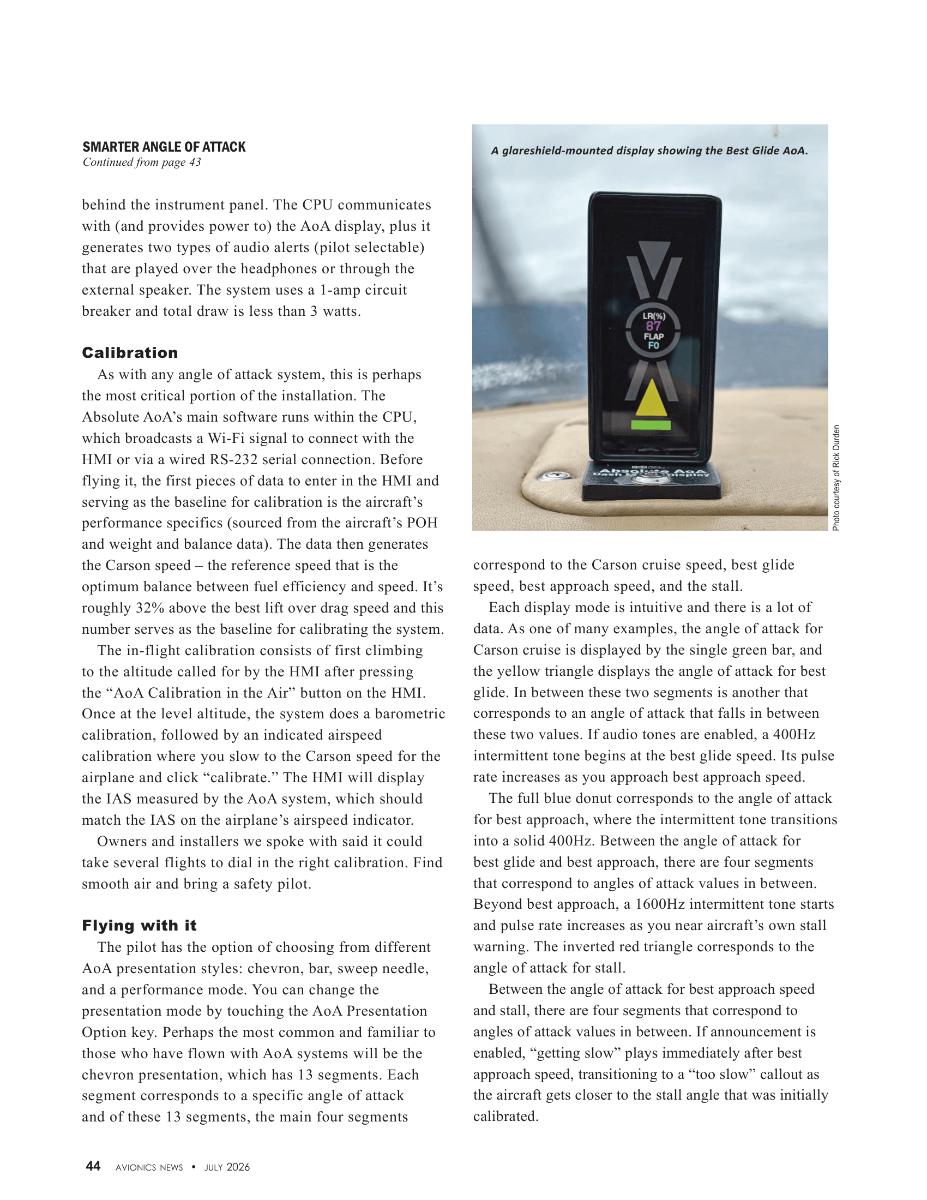
Holy Micro!’s Absolute AoA is featured in the July 2026 issue of Avionics News in the article “Smarter Angle of Attack” by Larry Anglisano. Discover how smarter Angle of Attack technology is helping pilots get better situational awareness and safer flight operations. Read the full article — Pages 42–45: https://digital.avionicsnews.net/publication/frame.php?i=866871/July2026

-
Thought this update might be of interest to the aviation community. Holy Micro! LLC has received FAA NORSEE Production Approval for its Absolute AoA Heated Probe System (Part Number: AOA-HP-01). The approval authorizes production of the heated probe configuration for the Absolute AoA system under 14 CFR 21.8(d) in accordance with FAA Policy PS-AIR-21.8-1602. The system is approved as a Supplementary Angle of Attack and Stall Warning System. The heated probe has been added as an option to the Absolute AoA system for operators who require probe heating. The approval covers production of the equipment, while installation must be completed in accordance with applicable FAA regulations and approved installation data. It's always encouraging to see additional NORSEE-approved equipment becoming available, giving aircraft owners more choices for adding supplementary safety-enhancing equipment to their aircraft. Has anyone here installed NORSEE equipment on their aircraft? I'd be interested to hear about your experience.
-
- 1
-

-
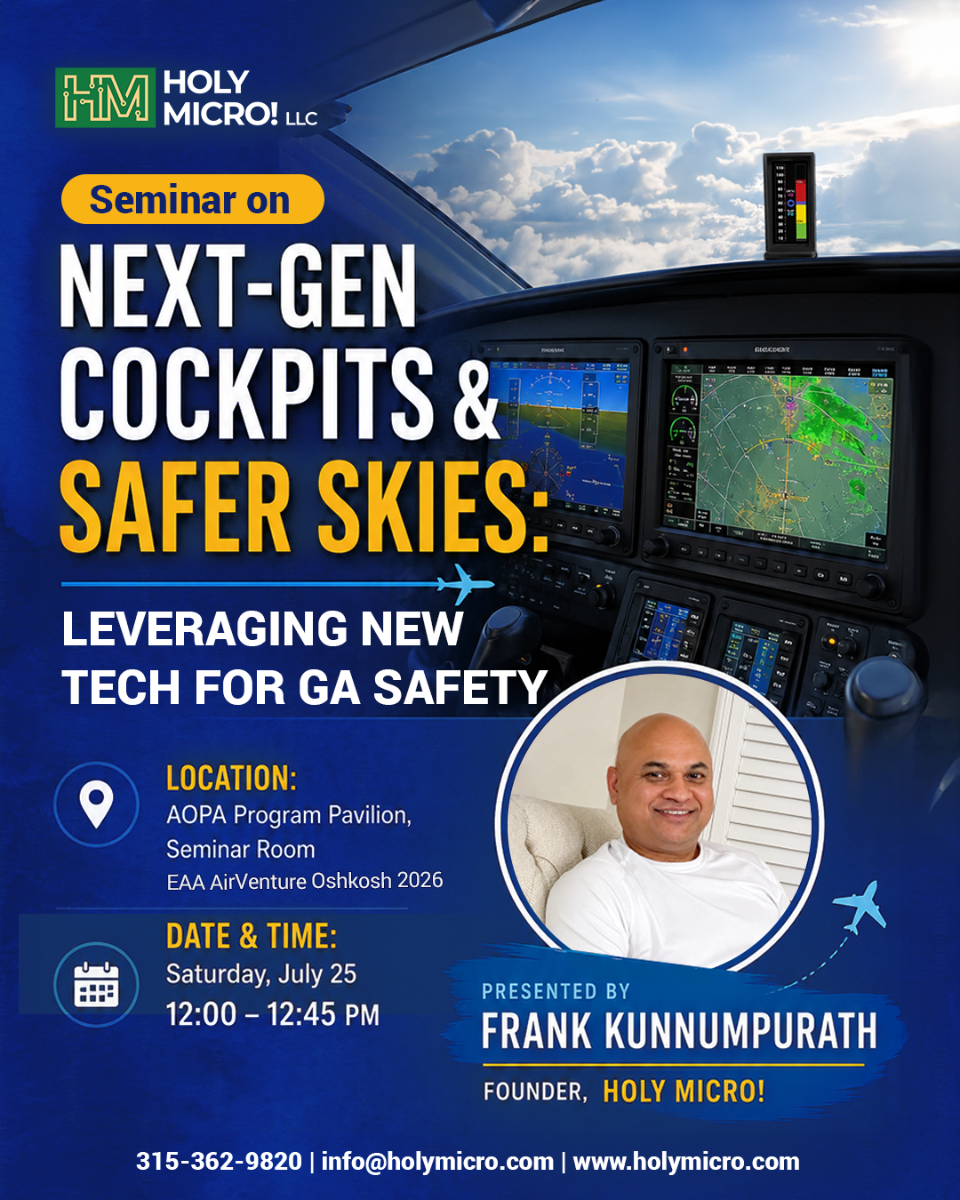
Join us for an insightful seminar exploring how emerging technology is transforming general aviation safety! Topic: Next-Gen Cockpits & Safer Skies: Exploring New Technologies for General Aviation Safety Location: AOPA Program Pavilion, Booth 463 (EAA AirVenture Oshkosh 2026) Date: Saturday, July 25 Time: 12:00 PM – 12:45 PM Our Booth - Hangar C, Booths 3149 and 3150 Presented by Frank Kunnumpurath, Founder of Holy Micro! LLC Call: 315-362-9820 | [email protected] Website: http://www.holymicro.com
-
Join Us Live at EAA AirVenture 2026 Beyond the Glass Panel: Smarter Tech for Safer, Easier Flying - What if your cockpit could catch a taxi mistake before you cross the hold short line, auto-transcribe a garbled ATIS broadcast, and detect a microscopic engine anomaly long before it turns into a rough ride over the mountains? The next revolution in General Aviation isn't about adding more expensive screens; it's about giving you unprecedented safety, precision, and peace of mind. Join us for a practical look at upcoming, highly affordable technologies that will transform your flying. Discover how centimeter-accurate ground tracking is virtually eliminating runway confusion, how non-invasive wireless sensors track airframe stress and propeller balance in real time, and how next-gen 3D spatial awareness is completely outperforming traditional synthetic vision. We will also dive into foolproof, touchless fuel tracking and intelligent audio systems that auto-tune and filter cockpit noise. Whether you fly a vintage taildragger or a high-performance piston, come see how tomorrow’s tech will drastically reduce your workload, protect your airframe, and keep you steps ahead of your airplane. Want to see how tomorrow’s tech will drastically reduce your workload, protect your airframe, and keep you steps ahead of your airplane? Check out the presentation details below and join us live at AirVenture: Join Frank Kunnumpurath, Founder & CEO of Holy Micro! LLC, for an educational seminar titled Next-Gen Cockpits & Safer Skies: Leveraging New Tech for GA Safety. The presentation will be held in the AOPA Program Pavilion Seminar Room during EAA AirVenture Oshkosh 2026 on Saturday, July 25, 2026, from 12:00 PM to 12:45 PM. Whether you're attending the seminar or exploring AirVenture throughout the week, stop by our booth to see these technologies in action and speak with the team behind them. What You'll Find at the Booth Absolute AoA is an An FAA NORSEE-approved NewGen solution designed to provide accurate Angle of Attack (AoA) for all phases of flight. This advanced system provides reliable AoA information for climbing, cruising, & landing, unaffected by density altitude, or weight/loading. SkyVoice Alert 500 is the only Take-off and Landing Height Announcer with LiDAR range of 590ft and repeated Gear warnings from 560ft until the gear is down & locked. It features with many user selectable Reminders on take-off and landing. FAA NORSEE approved. SkyVoice Glassy Guide 400 from Holy Micro! LLC, is a RADAR based 400 ft Take-off and Landing Height Announcer for Seaplanes/Amphibians. It featured with many user selectable Reminders on take-off and landing. The SkyVoice Glassy Guide 400 has a portable option also. It features the same hardware and software as the certified version. Stack-Pass MixAmp One of our introductions this year is Stack-Pass, designed to bypass the complexities of existing audio panels, saving you thousands in installation costs while guaranteeing you never miss a critical alert. Massive EAA AirVenture Savings Holy Micro! is dismantling the "Brand Tax" on Safety. Attendees can take advantage of a massive $1,200 discount on the SkyVoice + Absolute AoA combo purchase at the show. Individually, the SkyVoice Alert 500 or SkyVoice Glassy Guide 400 is available at a special show price of $1,300, while the Absolute AoA System is offered at a special price of $2,150. Visit Holy Micro! at Hangar C, Booths 3149 & 3150 throughout EAA AirVenture Oshkosh 2026 (July 20–26) to experience our latest aviation safety innovations, enjoy live product demonstrations, meet the team, and take advantage of exclusive AirVenture show pricing. Eliminate the gamble. Know your AGL. Fly your wing. Fly with Holy Micro! products.
-
Hi everyone, We are excited to share that Holy Micro! was recently featured in the June 2026 issue of Aviation Digest (Volume 42, Issue 11). The article, found on pages 11 and 12, is titled "How High-Fidelity Audio Could Mitigate the 'Impossible Turn'." discusses how real-time audio altitude callouts and enhanced situational awareness technologies can help pilots during critical low-altitude emergencies. As we continue to develop safety-enhancing technology for the GA community, we would love to get your feedback on the concepts discussed in the piece. You can read the full digital issue here: https://aviation-digest.blogspot.com/2026/05/june-2026-volume-42-issue-11.html (pages 11 and 12) Looking forward to hearing your thoughts and answering any questions you might have.
-
- 2
-
-

-
Feature Vane-Based System Pressure-Ratio Based System Primary Method Mechanical Alignment Pressure Ratio Complexity High (Mechanical components such as bearings and seals) Low (No moving parts) Installation Requires a precision-cut hole in the aircraft’s skin and complex internal electronics Can be bolted on or integrated into an existing plate, making it a much simpler retrofit for GA aircraft. Accuracy Accurate across all flight regimes. Accurate across all flight regimes, except during significant slips/skids. Maintenance Requires thorough inspection for sticking, wear, and damage before every flight. Low maintenance; primarily requires keeping the ports clear of debris. Failure Modes Mechanical jamming, bird strikes, icing, snow, or heavy rain; often fails without warning. Blocked ports (ice/bugs) or water in lines, but includes built-in diagnostic warnings. Weight/Size Larger, heavier, and creates more aerodynamic drag. Smaller, lighter, and creates lower drag. Target Aircraft Preferred for commercial airliners and fighter jets due to high sensitivity; typically 2 to 4 redundant units per aircraft. Widely popular in General Aviation because they are lighter, cost-effective, and easier to install. Summary If you are flying a high-performance jet where precision at Mach speeds is critical, a redundant vane-based system is the industry standard. However, for those flying light piston or turboprop aircraft who want a reliable, low-maintenance safety tool to prevent stalls and loss-of-control accidents, a pressure-ratio system is usually the more practical and cost-effective choice. Advanced pressure-ratio systems have the ability to sense blocked ports and produce appropriate cockpit warnings. Historically, fatal accidents resulting from relying on false indications from damaged vane-based systems have even forced some manufacturers of those systems out of business.
-
I wanted to share a recent AvBrief feature covering a flight trial of our Absolute AoA system. It goes into detail on real-world use, including calibration, stall behavior, and performance across different flight conditions. Might be relevant for anyone exploring AoA or safety-enhancing avionics: https://avbrief.com/holy-micro-absolute-aoa-flight-trial/