3rd harmonic
-
Posts
55 -
Joined
-
Last visited
-
Days Won
1
3rd harmonic's Achievements

Well-known member (3/3)
-
 From the brief video clip I can't see the landing gear out. I imagine if it was deployed when they hit at that speed it would have been ripped off the airframe! Given it seems to be intact, I'd say the gear has come loose after the fact.... Thanks for those who looked for the ADSB - no returns is interesting, hopefully the transponder was actually on.
 -
Further to the comments i made previously. Leo was a very measured, easy going kind of guy, who generally wasn't in a rush at any point. When he instructed me on incipient's, he LECTURED me at some length about doing stalls or spin practice at a safe height so as to be FULLY recovered by 3000ft He made the point that Martin, as a master pilot with a low level endorsement, could do so those maneuvers to a lower level legally. And I have seen Martin, doing spins in the great lakes biplane and because the biplane has reduced moment of inertia in the roll axis especially it spins in a tight cork screw VERY quickly. For everyone else that rule was LAW! Based on that i think it would be fair to say that what happened was NOT a planned maneuver. Has anyone found the ADSB track to know what height they were at, i gather it wasn't very high? As Nev said, there really is no obvious reason it should have happened, but no-one is beyond distraction and that may have been a factor given the training environment.
-
I haven't post on here for a while, mainly because my life has been too full (of other non aviation related things). You never think one of these accidents might happen to someone you know. I was fortunate enough to be instructed by on quite a few flights by Leo Howard some years ago at Adelaide Biplanes. Very surprised that he has been involved in a accident that's ended up this way - he had an aerobatic rating and If anyone knew how avoid and/or to recover successfully from a spin it was him. One day I remember I had turned up hoping to take the RaAus Aeroneca Champ for flight solo (they have also a VH reg one too) but I think there was a rough south easterly blowing and they had decided it wasn't such a good day for hire and fly. But he said, look we can still go go for a flight, so i said why don't we do some incipient spins because I felt i needed the practice, and it might be fun! We climbed to 3500 out over the water near Selicks hill, and we did spin entry, after spin entry, nose low, nose high, some with abit of power on. Some times we let it go a 1-2 turn before recovery. It was good practice, I enjoyed every second and the seeing the ground/sea whirling around became much more comfortable after the 4th or 5th one. On another flight again in the champ, we were doing circuits and he wanted to me to go around. From the rear seat i had no warning and he pushed the throttle open quicker and with abit of force. Unfortunately this caught my little finger and jammed between the curved slot and the throttle lever. After yelling OW, i was bleeding and making a mess in the plane. He apologised, to his credit he cut me a small bandage from a rag to contain the bleading, so i can say he was a kind individual. It really wasn't he best lesson, but memorable all the same... I really don't think it's a question of skill on his part, please don't assert otherwise, to do so would be dishonest. As Nev has pointed out it may not have been him flying, or he may not have been able to take control quickly enough. I hope the ATSB, can for once this find some answers as to why it all went so wrong, so quickly. Such a bugger, so bloody sad... 😭😭
-
Random Low Fuel Pressure Indication.
3rd harmonic replied to skippydiesel's topic in Engines and Props
Looks like my memory wasn't exactly accurate, found on the RAAus accident/occurrence page: OCC0871 28/12/2016 OCCURRENCE DETAILS SUBMITTED TO RAAUS: DEFECT: Failure of the outlet valve in the fuel pump caused a loss of power on take-off. Take-off aborted and aircraft landed on remaining runway. Part of the valve is pressed into the body of the pump. The part pressed into the body came out after - the outlet valve remained open which caused a drop in the fuel pressure. Note: the standby electric pump was 'On' however also lost pressure through this failed valve. OUTCOME: This aircraft is an LSA and as such this defect was reported to the manufacturer. Technical Manager reviewed the aircraft logbooks which was provided by the maintainer. The aircraft logbook showed that it has high hours and appears the fuel pump has failed due to fair wear and tear. -
Random Low Fuel Pressure Indication.
3rd harmonic replied to skippydiesel's topic in Engines and Props
One of the Sporty's with a 912ULS at Aldinga had a partial engine failure reduced power through lack of fuel flow. The return spring on the diaphragm pump was the issue, the spring could be broken/cracked and still work somewhat. They do a lot of hours and the pump may not have been changed even when the engine was changed due to expired TBO. One of the penumatic grease guns we use at work (broken spring) had similar symptoms, it would work sometimes?! -
Dynon Skyview Classic, ADAHRS Module
3rd harmonic replied to skippydiesel's topic in Instruments, Radios and Electronics
I have seen D connectors where the pin has been pushed back into the plug. In my context that is 8 channels of balanced audio on a DB25 using the TASCAM pinout - a faulty pin can result in losing half or 6dB of the signal, either the +hot or -cold. Looking at the Dynon installation manual and DB37 connector pinout there are 2x V+ power inputs (pins 1 and 20) and 4x ground pins (pins 21, 22, 23 and 24) for redundancy. Power and ground are right next to each other and the pins are also pretty close inside D connectors and it is very easy for even a single strand to come adrift and create an intermittent short circuit which could easily generate the funny resets ect I would open up the back shell on the DB37 plug and check that as a first port of call... -
Dynon Skyview Classic, ADAHRS Module
3rd harmonic replied to skippydiesel's topic in Instruments, Radios and Electronics
Hi Skip, It would appear logically that after multiple different units being installed/uninstalled the original issue may not have been resolved... I would be looking specifically at the grounding and or negative return to the battery. Some bits of gear will do all kinds of funny things when the ground is lost, intermittent or high impedance. If the main ground which is on the DB37 connector (I think) is faulty then current may be making its way back via the shields on the data Comms connections causing corrupted data. A 4-wire ohm meter is the weapon of choice to do this that can accurately measure fractions of an Ohm (egg 0.01) Check the plug, pins and crimps. With the plug disconnected and no power applied, check the resistance back to the battery. Aggravate, vibrate, tap things while doing these resistance checks If the resistance changes or goes higher than 0.5 ohms then that could cause those issues... It's a bit hard to explain exactly how to go about this, but hopefully that gives you some idea... -
N'interrompez jamais un ennemi qui est en train de faire un erreur ! Napoleon 'Never interrupt an enemy that is making a mistake!' One country in particular will stand to benefit from US division and isolationism. All they have to do is watch and wait...
-
Nice work on the AEG batteries and welding helmet it helps keeps the MONEYBOX full rather than empty😉!! It's the kind of stuff I do likewise.. I've got an 6Ah AEG battery that a mate gave me which unfortunately got flooded overnight when it rained (when it did actually rain some years ago) the cells are fine but the multi layer BMS PCB suffered electrolytic corrosion and is buggered! High temperatures are a fairly big deal for LiMnCO2 or LiFePO4 batteries, the BMS will often just disconnect the pack for safety. They especially DO NOT like being charged while hot, as that generates more heat internally - much better to let the batteries cool down before wacking them on charge. Yeah, those 12v LiFePO4 batteries are great for caravans/campers ect but a serious stand alone power system with a 24v or 48v bank is better resolved by using individual 3.2v block cells with separate BMS and cell balancing system (I was a CEC accredited designer of solar off grid stand alone power systems for a while)
-
Some understanding of contemporary 3-stage lead-acid battery charging might help: 1. Bulk stage: (constant current) the charger pushes the voltage higher at the max current it can source (or is selected) 5, 10, 20A ect 2 Absorb stage: (constant voltage) when the voltage gets to 14.2-14.5v, rather than pumping out max amps to push the voltage higher, the charger holds the battery voltage constant. The current into the battery should taper off as the charge is absorbed though ALL the material on the plates. 3. Float or maintenance stage: (constant voltage) generally after a perset time at the Absorb level the charger will drop the voltage back to around 13.2-13.8v, the current into the battery should be pretty low at this point. Any additional load across the battery can then be supplied by the charger while the battery is 'floating'. For lead acid batteries temperature strongly affects the charging end point voltages and this needs to be compensated for - correct charging of larger battery banks in fixed installations generally always has a temp sensor on the cells. Especially for batteries that are not used all the time, it is IMPERATIVE that they are charged to the absorb level regularly to avoid the plates becoming 'suphated' ---- To answer the question, a bench supply or an RV power supply will just float the battery and supply any load with master switch on which will work fine, although without any absorb stage. The regulators on traditional aircraft alternators are pretty low tech, generally they only float charge at no more than 13.8v and there isn't any basic temperature compensation that most automotive ones have featured since the 1980s. This tends to result in undercharging, suphation and early battery failure.
-
Those RV wall power supplies are much like a 13.8V bench supply with some current limiting at maybe 20-40A. But a 13.8v bench supply would be fine anyway, you ain't going to get 60A flowing even if can do it... Essentially, if the battery is in a reasonable state of charge at 12.5V, even 0.25ohm on a 1-2m of your connection cable to the battery which could be 8-10 AWG will limit the current into the battery by (13.8-12.5)/0.25 = 5.2A It will gulp abit of current initially, after some minutes it will push the battery volts up to the float level (13.8v) and the draw will be minimal, plus whatever is turned on in the plane.
-
Reregistering an RAA aircraft
3rd harmonic replied to Geoff_H's topic in Aircraft General Discussion
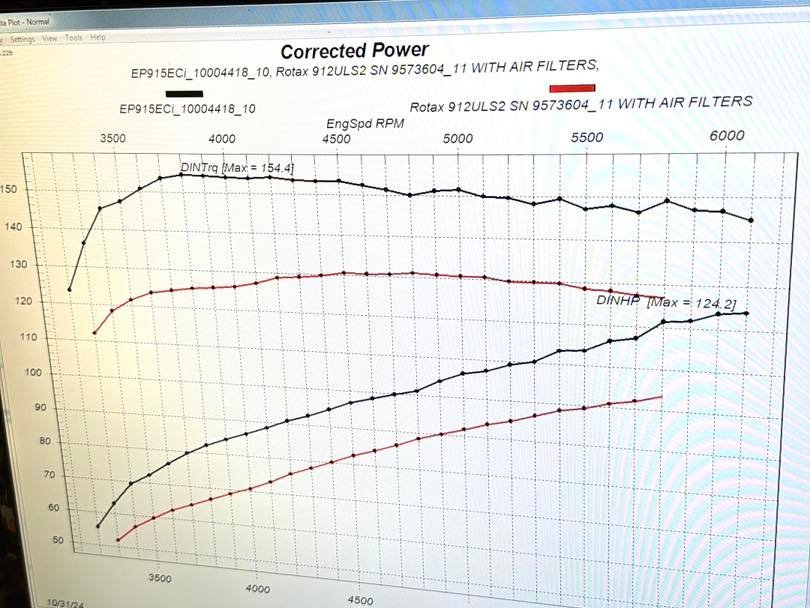
Yeah, his engines are bloody awesome! That graph I picked out compares the Edge performance 915 to a standard 912ULS. If you look elsewhere in his photos the Edge performance version of a standard 912, but injected, has a flat 130NM torque curve from 3700rpm upwards and is good for an extra 10-12hp. Because the motor breathing is so much better and the fueling is more consistent it uses a fair amount less L/hr for the same hp. -
Reregistering an RAA aircraft
3rd harmonic replied to Geoff_H's topic in Aircraft General Discussion
If you follow the EDGE PERFORMANCE FB feed, he often puts up VERY interesting dyno graphs of the engines he's produced or overhauled. These are ACTUAL measured results, not theoretical speculation. This one is particularly instructive, for the 912ULS the TORQUE curve is in reality pretty much flat above 4700RPM, HP increases are really due to increasing RPM. Over proping the engine with too coarse a pitch, will tend to 'slug' the engine, much like changing into a higher gear on a (manual) car at too lower a speed. It definitely not going to cause any damage because the engine can't do any more than the available torque at that rpm, but the horsepower developed will be down on what would otherwise be possible. I experienced this directly in the VH Sports-star with a CS prop, on one circuit when i forgot to set the prop rpm up to max, which as i recall was 5800rpm corresponding to 'full fine' pitch. We were still climbing away OK, but i was indeed 'slugging' the engine at about 4800rpm! Once that was pointed out, a quick flick of the dial allowed the motor to really scream at full noise and the performance change was quite noticeable...
-
Reregistering an RAA aircraft
3rd harmonic replied to Geoff_H's topic in Aircraft General Discussion
That list of items that are considered 'Line Maintenance' is pretty extensive and most of the items listed there could easily get you into big trouble and/or damage the aircraft if you didn't know what you were doing. I think they make some passing comment about people being competent to perform the task, but who decides that? Some people who might quite competent or experienced pilots, wouldn't know the difference between a left or right handed screwdriver! I would back my engineering/mechanical skills over my piloting skills every time, but that's just down to lack of experience in the latter. In a different life would love to have been a flight engineer - on those big complicated aircraft they are REALLY the ones in control 😉 -
Reregistering an RAA aircraft
3rd harmonic replied to Geoff_H's topic in Aircraft General Discussion
Yes, the park brakes were lock-wired down/off in the sporty's I flew which were used for instruction, i assume to avoid the chance of landing with the brakes on - probably a good idea with low time students. The inflight adjustable prop looks like a nice simple system to operate, assuming it's setup well and you keep an eye on the RPM. You'll have to let us know how it how goes when you (finally) do get it in the air!